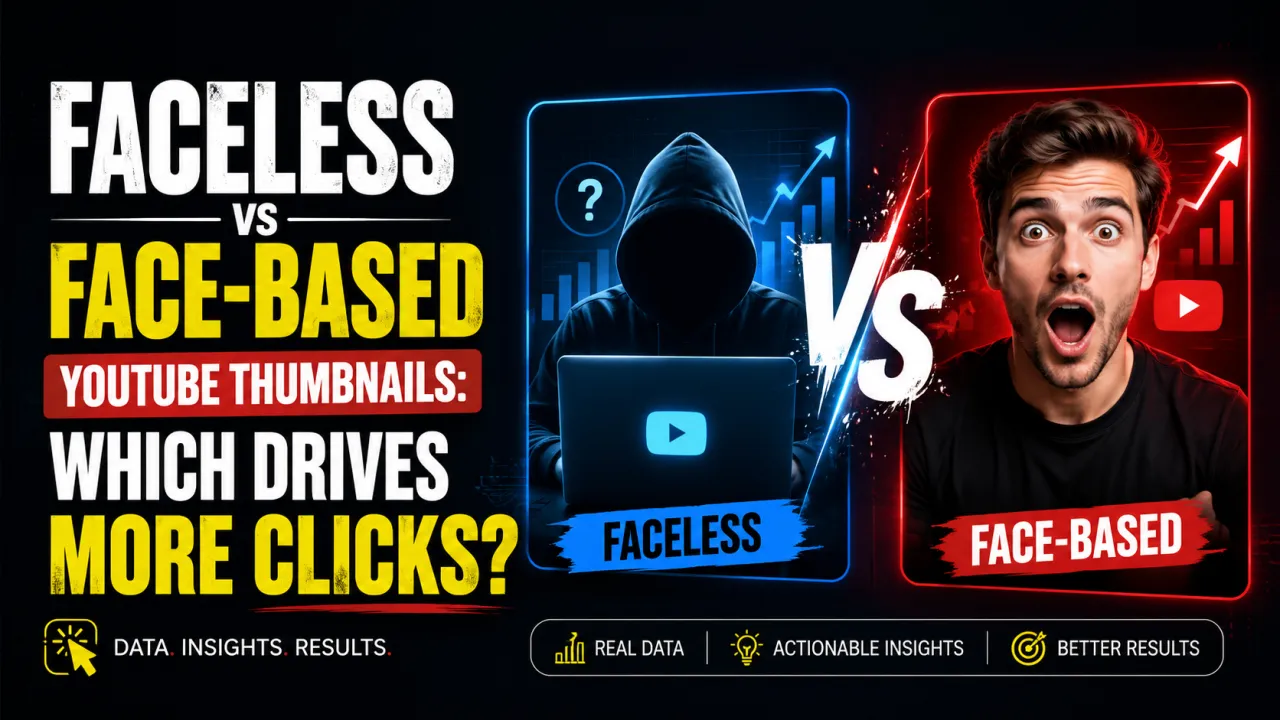
One of the most persistent questions in YouTube channel strategy is whether thumbnails should include a face. The short answer from published research and large-scale creator analysis is that face-based thumbnails produce higher average CTR in most niches but faceless thumbnails outperform in specific categories and situations where the subject matter is more compelling than any person could be.
The right choice depends on your niche, your channel's current scale, and what the video is actually about. This guide explains the psychology behind face thumbnails, the conditions where faceless thumbnails win, a niche-by-niche breakdown, and how to use A/B testing to determine what works for your specific audience.
For the design principles that apply regardless of which approach you choose, see the YouTube thumbnail best practices guide. For the composition techniques that determine how faces or objects should be positioned, see the thumbnail composition guide.
The Psychology Behind Face-Based Thumbnails
Humans are neurologically wired to detect and prioritise faces. The fusiform face area a region of the brain that activates specifically in response to faces processes face recognition faster and with less conscious effort than object recognition. This pre-conscious face detection means that a face on a thumbnail attracts attention in a viewer's peripheral vision before they have consciously decided to look at the thumbnail.
Eye contact amplifies this effect. A face making direct eye contact with the camera creates the "mutual gaze" response the viewer's brain interprets the face as looking at them personally. This creates a split-second personal connection that generates a stronger click impulse than a face looking away or an object with no eyes at all.
Facial expressions matter beyond the simple presence of a face. Thumbnails with exaggerated expressions shock, excitement, laughter, distress perform better than neutral or calm expressions in most niches. The expression signals the emotional content of the video and creates anticipation. If the video is shocking, the shocked face says "this will shock you" before the viewer reads a single word. Research from Wharton Business School and several large-scale YouTube creator analyses have consistently found exaggerated expression thumbnails outperform neutral ones by 1525% for CTR in high-energy content categories.
At channel scale, familiar faces carry additional CTR value. A subscriber who recognises a creator's face in a thumbnail has already partially committed to watching based on creator loyalty the face functions as brand recognition before any content evaluation occurs. This is why established creators often see declining CTR when they stop appearing in their thumbnails: the recognition element that was carrying clicks disappears.
When Faceless Thumbnails Outperform Faces
Faceless thumbnails outperform face thumbnails in situations where the subject of the video is more immediately compelling than any face could be, or where the niche audience has different content evaluation patterns than general viewers.
Programming and technical tutorials: A screenshot of code, a terminal output, a software interface, or a diagram communicates the technical subject immediately. For a viewer searching "how to deploy Docker on AWS," a thumbnail showing the Docker whale logo and AWS logo is more relevant than a developer's face. The subject matter of technical content is the draw not the presenter.
Food and cooking: Beautifully photographed food is consistently more click-generating than a chef's face in the cooking niche. Food photography triggers appetite responses that a face does not. The dish is the product showing the dish produces higher CTR than showing the person making it.
Gaming and screen capture: In gaming, the game visuals themselves action scenes, dramatic moments, rare items, character models are often more compelling than a reaction face. Top gaming channels have tested both approaches and many have found that at sufficient channel scale, game content thumbnails match or exceed face thumbnails for CTR. At smaller channel scale, where the creator's face is not yet recognised, game content thumbnails often perform better because they answer the viewer's primary question ("what game is this?") immediately.
Comparison and review content: A side-by-side product comparison, a before-and-after, or a product shot communicates the content type instantly. A face in the corner adds no information gain the product is the subject, and the thumbnail should show the product.
Documentary and nature content: Wildlife, landscape, and documentary thumbnails perform best with the subject of the documentary the animal, location, or phenomenon as the primary element. A face superimposed on a wildlife shot competes with and diminishes the impact of the subject matter.
Niche-by-Niche Breakdown: Face vs Faceless
Based on consistent patterns in high-performing thumbnails across major YouTube categories:
| Niche | Face thumbnails | Faceless thumbnails | Verdict |
|---|---|---|---|
| Personal finance | Shock/concern expression | Charts, money, numbers | Both effective; face wins for advice, data wins for analysis |
| Fitness and health | Transformation faces, expressions | Before/after body, exercise equipment | Face wins for motivation, subject wins for results content |
| Gaming | Reaction faces | In-game content, items | Equal at scale; game content wins for new channels |
| Cooking and food | Chef expressions (rare) | Food photography | Faceless wins by a significant margin |
| Technology reviews | Creator with product | Product shot alone | Creator + product (hybrid) wins; pure face loses |
| Programming and dev | Rarely used | Code, diagrams, logos | Faceless wins consistently |
| Lifestyle and vlog | Expressions, moments | Locations, activities | Face wins the creator IS the product |
| Education | Instructor expressions | Diagrams, text, concepts | Hybrid (face + concept graphic) wins |
| True crime and documentary | Occasionally | Subject matter, evidence | Faceless wins the story is the draw |
| Business and entrepreneurship | Authority expressions | Charts, results, visuals | Face wins for advice; results data wins for proof content |
How to Test Which Approach Works for Your Channel
The analysis above provides directional guidance, but the only definitive answer for your specific channel and audience is direct testing. YouTube Studio's Test & Compare feature allows you to upload two versions of a thumbnail for the same video and measure actual CTR across your real audience before committing to one.
To run a valid face vs faceless test:
- Before changing your current thumbnail, download and archive it using the HD thumbnail downloader this ensures you can restore the original if needed.
- Design two versions of the thumbnail: one with a face, one without. Keep all other variables constant (color palette, text, text position) change only the face vs no-face element.
- In YouTube Studio, navigate to the video's details page and click "Test & Compare" in the thumbnail section.
- Upload both thumbnails. YouTube will show each version to a different portion of your audience and track CTR.
- After 714 days, YouTube will indicate which thumbnail received higher CTR. Select that version as the permanent thumbnail.
For the complete A/B testing workflow including how YouTube picks a winner and what to do when Test & Compare is not available on your account see the YouTube thumbnail A/B testing guide.
Frequently Asked Questions
On average, yes — face thumbnails produce higher CTR than faceless thumbnails across most content categories, according to published creator research and YouTube's own indirect signals. However, the advantage is niche-dependent. In food, programming, gaming, and documentary content, faceless thumbnails frequently match or exceed face thumbnail performance. The right answer for your specific channel requires testing, not assumption.
Yes — Many channels with millions of subscribers use faceless thumbnails consistently — programming tutorials, nature documentaries, cooking channels, stock market analysis, and ASMR content are prominent examples. The faceless approach requires that the subject matter of your videos is visually compelling enough to carry CTR without the face recognition shortcut. High-quality subject photography and strong thumbnail composition become more important.
Exaggerated expressions — genuine shock, excitement, laughter, or concern — consistently outperform neutral and calm expressions in thumbnail research. The expression should match the emotional content of the video: a shocked expression on a factual tutorial misleads the viewer, which increases click-through rate but damages watch time and subscriber retention. Match the expression to the actual emotional tone of the content.
Direct eye contact with the camera (and therefore the viewer) produces stronger click impulses than looking off-frame. However, if there is a key object or graphic in the thumbnail, having the face look toward it — rather than directly at the camera — can guide the viewer's eye to the secondary element. Consider what the face is "saying" with its gaze: camera = connect with viewer; off-camera = "look at this."
A small face in the corner performs significantly worse than a face that occupies a substantial portion of the frame. At MQ resolution (320×180), a small face loses all expression detail and its emotional communication value disappears. If a face appears in a thumbnail, it should be large enough to show expression clearly at the smallest display size. If the face cannot be made large enough to be legible, it is often better to go faceless.
Check your YouTube Studio analytics for Click-Through Rate (CTR) on videos with face thumbnails versus faceless thumbnails across your upload history. If face thumbnails consistently show higher CTR for comparable videos, they are working. If there is no consistent difference, other factors (title, hook, topic) are likely more influential than face presence for your specific audience. The most accurate test is the YouTube Studio Test & Compare feature on a single video with identical conditions.
A hybrid thumbnail includes both a face and a strong subject element — a tech reviewer with the product they are reviewing, a fitness creator next to before/after results text, a cooking creator beside the finished dish. The hybrid approach leverages the attention-capture of the face while also communicating the subject immediately. For technology, education, and personal finance content, hybrids often outperform both pure face and pure faceless thumbnails.