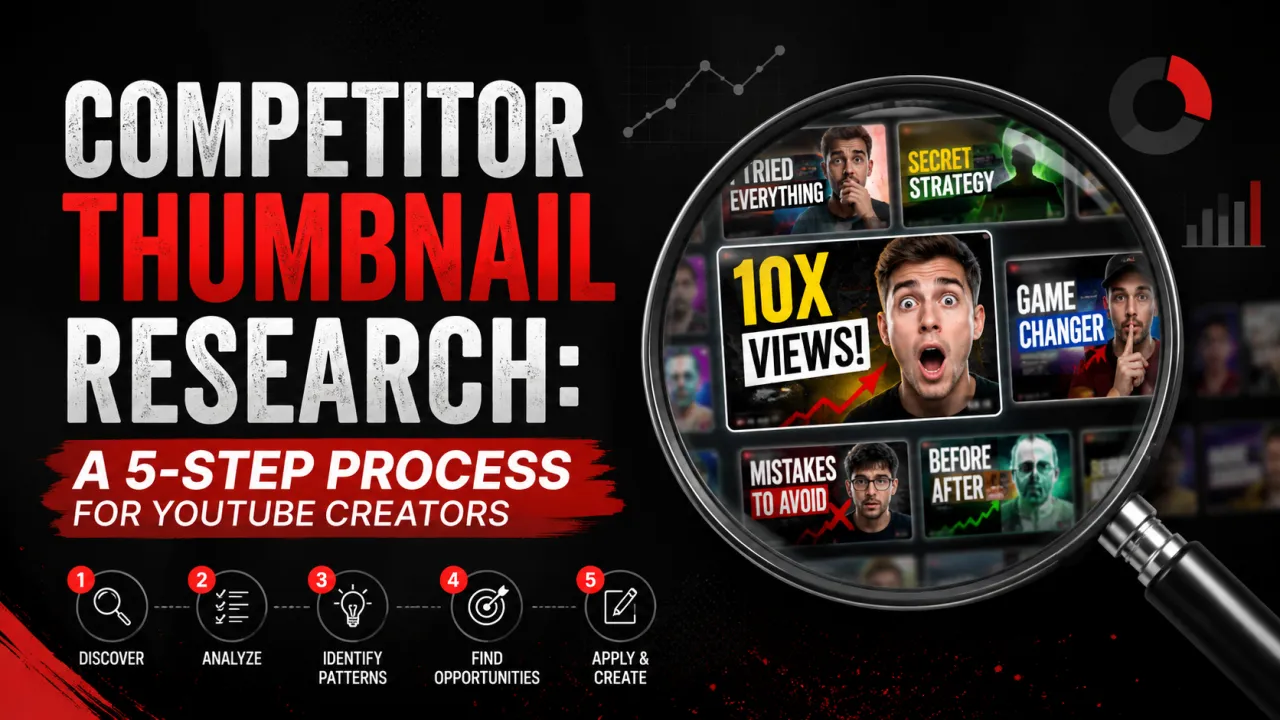
Studying competitor thumbnails is one of the most direct ways to understand what visual patterns are driving click-through rates in your niche. The top-ranking videos in any YouTube search result are a real-time signal of what thumbnails Google and YouTube's algorithm considers relevant and engaging for that query. This 5-step process gives you a structured way to extract and act on that signal.
Step 1: Identify Your Target Search Queries
Start with the YouTube search queries your videos are targeting or competing for. These are the queries where your thumbnail appears in the same results grid as competitor thumbnails the context where your design must stand out or blend in.
Find these queries in YouTube Studio under Analytics → Reach → Impressions by source → Search. Sort by impressions to find the queries bringing the most exposure. These are the competitive contexts worth analysing first.
Step 2: Download the Top 10 Thumbnails for Each Query
Search each target query on YouTube in a private/incognito window (to avoid personalisation bias). Take a screenshot of the search results grid. Then for each of the top 10 results:
- Click the video to get its URL.
- Go to YouTubeThumbnailImage.com and paste the URL.
- Download the HD (1280×720) version.
- Name the file with its position in search results (e.g.,
pos1-channel-name.jpg).
This gives you a local folder of the top 10 thumbnails at full resolution for analysis. Having the HD files rather than screenshots lets you examine fine details font choices, texture, shadow use that are not visible at search result display size.
Step 3: Identify the Recurring Visual Patterns
Open all 10 thumbnails side by side and look for patterns across the top performers. Key attributes to note:
| Attribute | What to observe |
|---|---|
| Faces | Do top results use faces? What expressions? Close-up or mid-shot? |
| Colour palette | Are dominant colours warm or cool? Saturated or muted? |
| Text | Do thumbnails include text? Bold or subtitle-style? How many words? |
| Composition | Is the subject left/right/centre? Is there a clear focal point? |
| Background | Solid colour, gradient, real environment, or blurred? |
| Brand consistency | Do certain channels have a recognisable visual style across all their thumbnails? |
Document what the majority of top performers share. These shared elements are the visual language of your niche what the algorithm has learned viewers in this category click on.
Step 4: Identify What Is Missing or Overdone
After identifying the dominant pattern, look for what none of the top 10 thumbnails do and whether that gap represents an opportunity or an avoidance. Ask:
- If every top thumbnail uses a face, would a strong graphic-only thumbnail stand out by being different?
- If all thumbnails use the same colour palette, does using a contrasting colour make yours pop in the grid?
- If no thumbnail uses text, does adding a specific number or keyword give yours an informational edge?
The goal is not to copy the dominant pattern exactly it is to understand the pattern well enough to decide consciously whether to follow it (fit in) or deviate from it (stand out). High-performing channels often use one or two elements that deliberately diverge from the niche convention while conforming to everything else.
Step 5: Apply Findings and Test
Before uploading a new thumbnail, download your current thumbnail using YTI and save it locally. Upload the redesigned thumbnail to YouTube Studio. If your channel has access to Test & Compare, use it the native A/B test will show you within two weeks whether the new design improves CTR. See How to A/B Test YouTube Thumbnails for the full process.
Repeat this research cycle quarterly niche visual conventions change as the most successful channels iterate their designs and set new standards. A competitive thumbnail analysis from six months ago may not reflect the current dominant pattern for a fast-moving niche.
When you have two contenders, line them up with the A/B Thumbnail Comparison tool to judge which reads more clearly at grid size.
Frequently Asked Questions
The top 10 results for each target query is a reliable sample. For a niche with high competition (many videos targeting the same keywords), expanding to 20 gives you a clearer picture of patterns vs outliers. For very specific long-tail queries with fewer competing videos, even 5 is sufficient for directional insight.
Top-ranked (search position) for your target queries is more relevant than most-viewed overall. A video with 10 million views uploaded five years ago may rank due to age and backlinks rather than thumbnail effectiveness. Recent videos in positions 1–5 for your target query are the most actionable competitive benchmark.
Yes — Studying design conventions and applying insights to your own original work is standard creative practice across all visual media. The restriction is copying — using another creator’s actual thumbnail image or creating a design so similar it constitutes plagiarism. Drawing inspiration from a colour palette or composition approach is not copying.
For active channels publishing weekly, a monthly or quarterly research cycle is appropriate. For channels in fast-moving niches (gaming, tech reviews, current events), monthly research keeps you current. For slower-moving evergreen niches (cooking, education, personal finance), quarterly is sufficient.