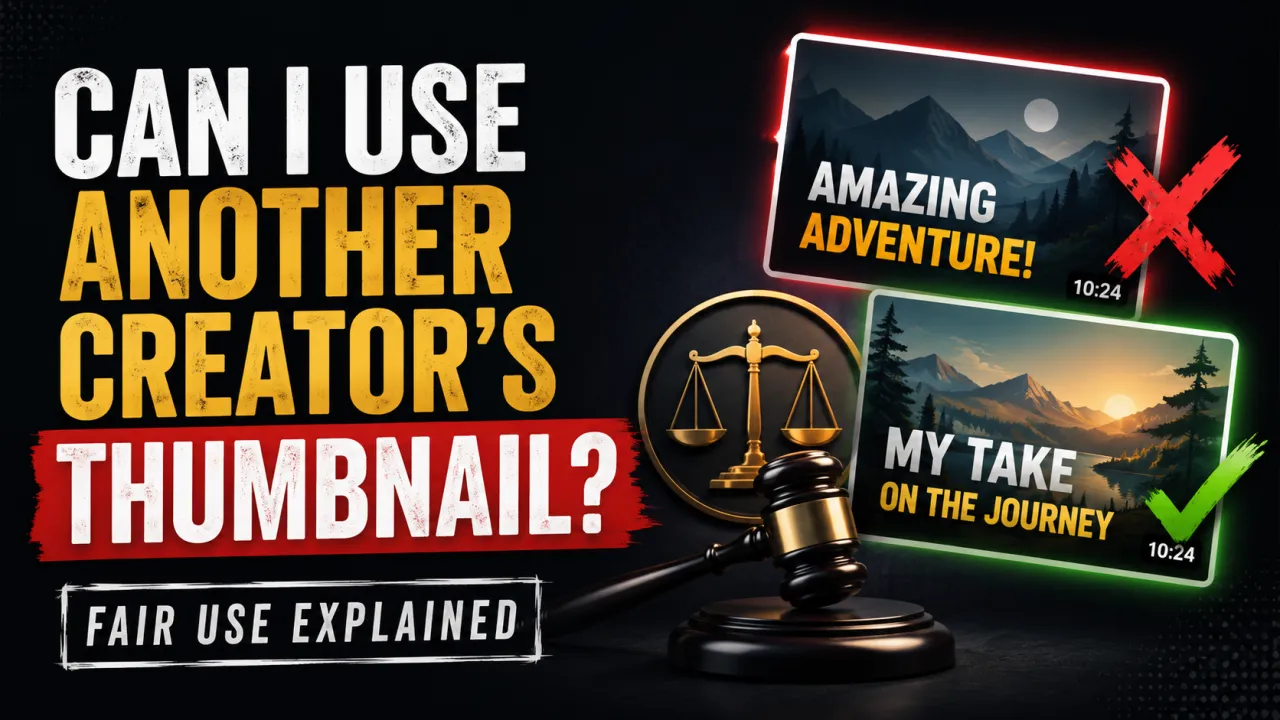
A YouTube thumbnail is a copyrighted image. The creator or rights holder who produced it owns the copyright. Using that thumbnail without permission in your own video, on your website, in promotional materials, or anywhere else is copyright infringement unless a specific exception applies.
The most commonly misapplied exception is fair use. Fair use is a US copyright doctrine that permits certain uses of copyrighted material without permission but it is narrower than most people assume, and it is not a blanket licence to use any content you find online. This guide explains what fair use covers, what it does not, and what alternatives exist for creators who want to reference or discuss another creator's thumbnail.
For the complete legal framework covering YouTube thumbnails, see the guide to YouTube thumbnail legality. For who owns thumbnails and how YouTube's licence works, see the YouTube thumbnail copyright guide.
Who Owns a YouTube Thumbnail?
Copyright in a thumbnail belongs to whoever created it typically the YouTube creator or a designer hired to create it for them. When a creator uploads a custom thumbnail to YouTube, they retain copyright ownership. YouTube receives a licence to store and display the thumbnail as part of the platform's operation, but copyright does not transfer to YouTube.
Thumbnails that incorporate third-party content licensed stock photography, frames from a movie or TV show, brand logos are more complex. Copyright in the underlying elements belongs to the original rights holders, not to the YouTube creator who assembled the thumbnail. A thumbnail that uses a movie still is covered by the film studio's copyright, not the YouTube creator's.
Auto-generated thumbnails frames that YouTube automatically selects from a video when no custom thumbnail is uploaded are screenshots of the video content. Copyright in those images belongs to the creator of the video, which is typically the same person.
What Fair Use Covers and Does Not Cover
US copyright law (17 U.S.C. § 107) provides a fair use defence for certain uses of copyrighted material based on four factors: the purpose and character of the use, the nature of the copyrighted work, the amount used relative to the whole, and the effect on the market for the original. Courts weigh all four factors no single factor is decisive, and fair use is determined case by case.
Fair use is most likely to apply to:
- Commentary and criticism: Showing a thumbnail in a video essay that critically analyses that thumbnail discussing its design choices, its messaging, its manipulation techniques is commentary. Using the thumbnail as the subject of direct analysis is likely fair use.
- Parody: Creating a thumbnail that parodies another creator's thumbnail transforming it in a way that comments on the original may be protected. Parody requires transformation and comment on the original; merely copying with a funny caption is not parody.
- Education and research: Using a thumbnail as an example in educational content about thumbnail design, copyright, or YouTube strategy where the thumbnail illustrates a point rather than replaces the original is the type of use fair use was designed to protect.
- News reporting: Reporting on a controversy involving a specific thumbnail, where the thumbnail is the subject of the reporting, may be fair use.
Fair use is very unlikely to apply to:
- Repurposing: Downloading another creator's thumbnail and using it as your own as a thumbnail for your video, in your channel art, as a social media graphic is not fair use under any reasonable interpretation of the doctrine.
- Compilation or aggregation: Building a collection of thumbnails for aesthetic purposes without commentary or transformation does not qualify as fair use.
- Commercial use without transformation: Using a thumbnail in paid advertising or promoted content without transformative commentary is unlikely to be fair use regardless of the intended context.
What You Can Legally Do With YouTube Thumbnails
The following uses are generally permissible without copyright concerns:
Viewing and studying for personal research: Looking at thumbnails to understand design patterns and strategies is not copyright infringement there is no legal issue with looking at any publicly displayed image. Downloading for personal reference and study, not shared or republished, falls into a legal grey area but is generally considered acceptable under fair use factors, particularly purpose (non-commercial, educational) and market effect (no impact on the rights holder).
Commentary and criticism: Referencing a thumbnail in a video that directly discusses or critiques that thumbnail is the core fair use scenario. The thumbnail is shown to support commentary about it the use is analytical, not substitutive.
Using your own thumbnails freely: Your own thumbnails are your copyright. Download them using the free YouTube thumbnail downloader, repurpose them, archive them, use them in promotional materials you hold the rights.
Creating inspired-by designs: Copyright protects specific expression, not ideas or styles. You can study another creator's thumbnail composition, colour scheme, and layout approach and create your own thumbnail inspired by the same aesthetic. You cannot copy the specific image but you can create an original design that uses similar principles. Inspiration is not infringement.
What Happens If You Use a Thumbnail Without Permission
If you use another creator's thumbnail without permission and the fair use defence does not apply, the rights holder has several enforcement options:
YouTube Content ID: If the original thumbnail is part of a video covered by Content ID, YouTube may automatically detect the use and take action blocking, monetizing on behalf of the rights holder, or tracking.
DMCA takedown: The rights holder can submit a DMCA takedown notice to YouTube or to any platform hosting the infringing content. A DMCA strike on a YouTube channel has significant consequences, including content removal and account restrictions.
Legal action: Rights holders can pursue civil claims for copyright infringement. Under the US Digital Millennium Copyright Act, statutory damages for infringement can reach $150,000 per work for willful infringement. In practice, litigation between individual creators is rare, but not unheard of for commercial or large-scale infringement.
Permitted uses are defined by the platform rules; read our plain-English YouTube Terms of Service summary for thumbnails.
Frequently Asked Questions
You can use another creator's thumbnail in your video if the use qualifies as fair use — commentary, criticism, parody, or education where the thumbnail is the subject of analysis. Simply showing someone else's thumbnail as eye candy, decoration, or to reference their video without comment does not qualify. When in doubt, use the thumbnail in a clearly analytical context or seek permission from the creator.
Using someone else's thumbnail on your website without permission is copyright infringement unless your use qualifies as fair use. If you are writing an article that critically analyses or discusses that specific thumbnail, showing it as part of that analysis is likely fair use. Embedding it as decoration, using it to promote a product, or placing it in any non-analytical context is infringement.
Reaction videos occupy a legally unsettled position on the fair use spectrum. Using a thumbnail as part of a reaction that directly discusses and provides commentary on the thumbnail's design or messaging is more likely to qualify as fair use than using it purely as an attention hook with no commentary. The transformative purpose and the commentary element are the key factors courts consider.
Taking a screenshot of a thumbnail for personal reference and private study is generally considered fair use — the use is non-commercial, does not substitute for the original, and does not harm the rights holder's market. Publishing, sharing, or commercially using that screenshot crosses into infringement. For higher-quality downloads than screenshots provide, the YTI thumbnail downloader retrieves the original CDN file at full resolution.
Downloading for personal research and study is generally acceptable under fair use principles. Downloading to republish, repurpose, or commercially use without the rights holder's permission is infringement unless your specific use qualifies as fair use. The act of downloading itself is not inherently infringing — what matters is what you do with the file after downloading it.
No — Copyright protects specific expression — the particular image — not ideas, styles, colours, or design approaches. A creator cannot copyright the concept of a yellow background thumbnail or the bold text style. They can only protect the specific thumbnail they created. You can freely study and draw inspiration from any thumbnail style without copyright concern — you just cannot copy the specific image.
If another creator or website is using your thumbnail without permission and you want to enforce your copyright, you can submit a DMCA takedown notice to the platform hosting the content. On YouTube, use the copyright complaint form in the Help Center. On other platforms, each has its own DMCA process. For serious or commercial infringement, consult a copyright attorney. For guidance on protecting your own thumbnails, see the copyright guide.